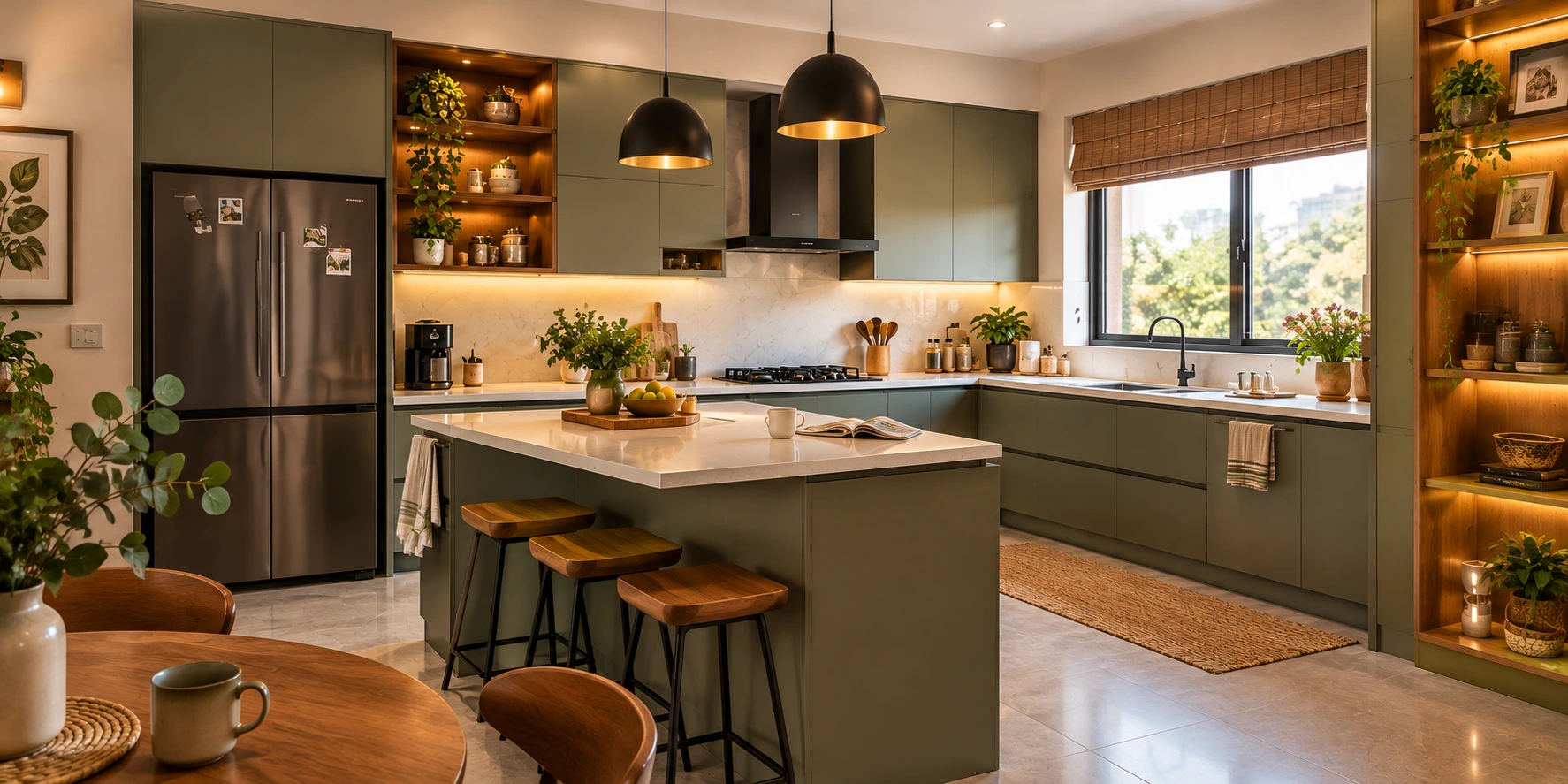
Think about where your family actually ends up at 9 pm. Chances are it’s the kitchen, with someone stirring chai, someone else leaning on the counter, and a guest who swore they’d “just stay five minutes.” The kitchen stopped being a back-room cooking spot a long time ago. It’s the busiest room in the house.
And yet plenty of us are still cooking in cramped corners, digging through cabinets for the one pan we need, and watching cheap boards swell up after a single monsoon. Throw in daily tadka, steam and oil splatter, and a badly planned kitchen starts to wear on you fast.
The good news is that this is fixable. A well-planned modular setup, built from factory-made units fitted around how you really cook, solves most of these headaches before they start. This guide walks through layouts, materials, storage, lighting and honest costs. If you’d rather have experts handle it end to end, Interiors Enclave offers turnkey design, from the first site measurement to the final handover.
What Is a Modular Kitchen and Why Do You Need One?
Understanding the Concept
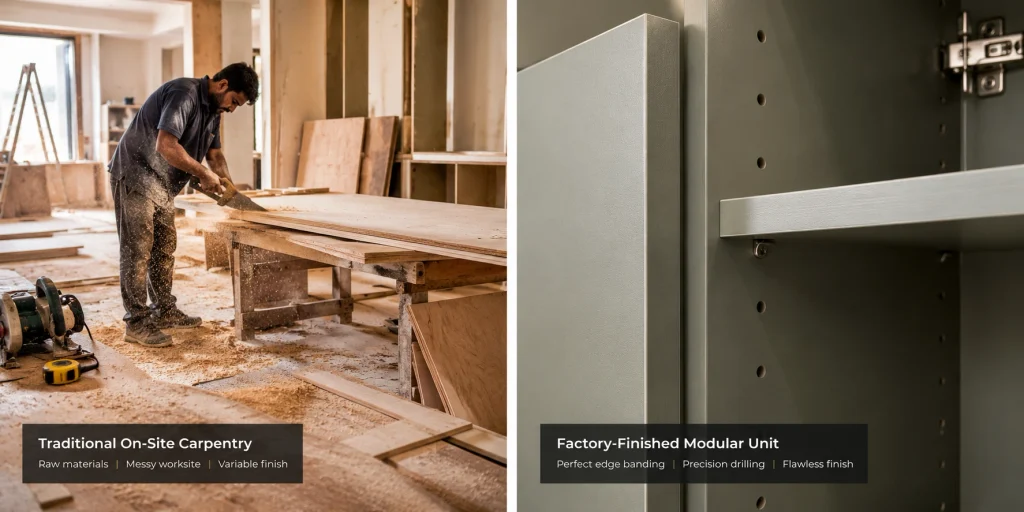
In the old way of doing things, a carpenter turns up at your house with raw plywood and builds everything on site. Here, the cabinets are made in a factory on precision machines, then brought to your home and fitted together. Every unit has a job: one for cutlery, a tall one for groceries, a deep corner unit for your big vessels.
Modular vs. Traditional Carpentry: A Quick Comparison
| Factor | Modular | Traditional Carpentry |
| Cost | Higher upfront, better value over the years | Cheaper at first, repairs add up |
| Durability | Uniform quality, moisture-tested boards | Depends heavily on the carpenter |
| Installation time | Around 3–4 weeks after design sign-off | Often 6–8 weeks of messy on-site work |
| Customization | Many sizes, finishes and accessories | Fully custom, but slower to finish |
Key Benefits of Going Modular
- Easy upkeep: Sealed, smooth surfaces clean up with one wipe.
- Smarter use of space: Even a tiny kitchen feels organized when every corner has a purpose.
- A cleaner look: Handleless doors and matching finishes give that sleek, magazine-style feel.
- Room to grow: If one drawer or cabinet gives up, you replace that unit, not the whole kitchen.
Choosing the Right Kitchen Layout for Your Floor Plan
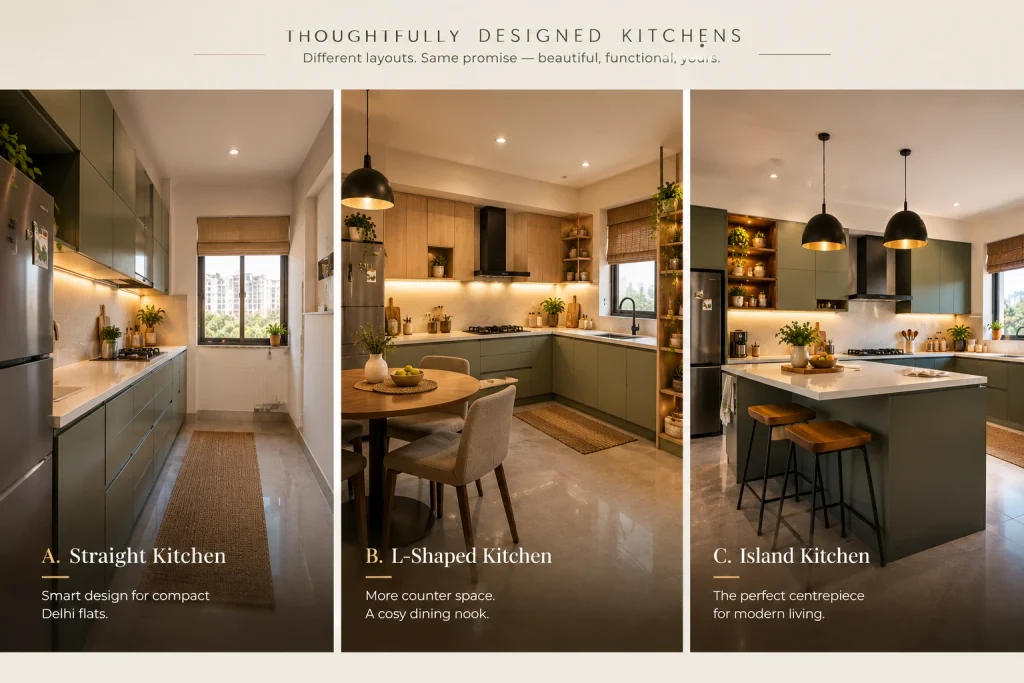
Before picking colours, sort out the kitchen layout. Designers rely on something called the work triangle, which is simply the distance between your sink, hob and fridge. Keep those three close but not crowded and cooking feels smooth. Spread them too far apart and you’ll clock up steps like you’re training for a marathon.
Here are the five layouts you’ll come across most often.
The Straight Kitchen. Everything sits along one wall. It’s a natural fit for studio flats and compact homes, and it’s the most budget-friendly. The trade-off is limited counter space.
The L-Shaped Kitchen. Two walls meet at a corner, forming a built-in triangle. This is the all-rounder for medium-sized homes. You often get space for a small breakfast nook too.
The Parallel (Galley) Kitchen. Two facing rows with a walkway between them. Everything stays within arm’s reach, which makes it brilliant for narrow rooms. Leave around a metre of walking space so two people can pass.
The U-Shaped Kitchen. Cabinets wrap around three walls. You get loads of storage and long stretches of counter, so it works well for big families and passionate home chefs who want separate zones for chopping, cooking and washing up.
The Island Kitchen. An island adds prep space, casual seating and a spot where everyone gathers. It’s the dream layout for open-plan homes, but it needs room, usually about 10 x 12 feet at minimum.
Selecting the Right Materials & Finishes
Delhi/NCR throws a lot at your home: sticky monsoons, dry summers and dusty winters. Add the grease and steam of everyday Indian cooking, and your materials have to be tough. They need to resist moisture, heat and termites, or you’ll see the damage within a couple of years.
Core Cabinet Materials: What Goes Inside?
BWP Plywood vs. MDF vs. Particle Board
- BWP (Boiling Water Proof) plywood: The sturdiest of the three. It copes with spills, steam and heavy loads, and termites tend to leave it alone. Use it around the sink and hob.
- MDF: Smooth and great for fancy finishes, but it soaks up water and swells. Keep it for wall cabinets, well away from taps.
- Particle board: The cheapest option and the weakest in humid conditions. I’d skip it anywhere near water.
For most Indian homes, BWP plywood for the base units and moisture-resistant board for the wall units strikes a sensible balance.
External Finishes: Making Your Kitchen Look Stunning
Laminates. Affordable, available in endless colours and textures, and simple to maintain. A smart pick for first homes and rentals.
Acrylic. Glossy, deep in colour and a bit premium. It stands up well to scratches and fading, though fingerprints show on darker shades.
PU (Polyurethane) paint polish. Seamless and rich, with a depth other finishes can’t quite match. It looks stunning, but it costs more and needs skilled application.
Countertop Materials
Granite vs. Quartz vs. Corian
- Granite: Handles heat well and lasts for years, but it’s porous, so it needs sealing from time to time.
- Quartz: Engineered, non-porous and resistant to stains. It tolerates heat, though a red-hot pan can leave marks, so keep a trivet handy.
- Corian: Seamless joints and a soft, modern look. It scratches and burns more easily, but marks can be sanded away.
Smart Storage Solutions & Kitchen Hardware
A gorgeous modern modular kitchen design that’s annoying to use is still a bad kitchen. Good kitchen storage, smart modular cabinets, and well-organized drawers are what make daily cooking feel easy.
Maximizing Every Inch
Tandem drawers and pantry units. Full-extension drawers let you see everything at once, and tall pull-out pantries keep groceries in plain sight instead of buried at the back.
Corner solutions. Magic corners and carousel units swing or slide out, turning that awkward dead space under the counter into real storage for large pots and appliances.
Cutlery trays, thali baskets and bottle pull-outs. These small inserts keep spoons sorted, plates upright, and oil bottles and masala jars close at hand.
Choosing the Right Hardware Brands
You touch hardware every single day, so it’s worth getting right. Look for soft-close hinges that stop doors from slamming, telescopic channels that glide under heavy loads, and hydraulic lifts for overhead cabinets. Hettich, Blum and Hafele are well-known names with solid warranties. This is one place I’d never cut costs, because a cabinet is only as good as the fittings that move it.
How Much Does a Modular Kitchen Cost in India?
Prices vary a lot, and that’s mostly because of the choices you make: material, finish, accessories and layout. Knowing what pushes the price up or down helps you plan without nasty surprises.
Budget-friendly: Laminate finish, BWR plywood and basic accessories usually land between ₹.5 and ₹1.5 lakh for a standard-sized kitchen.
Mid-range: Acrylic finish, branded channels and a quartz countertop typically cost around ₹1.5 to ₹5 lakh.
Luxury and high-end: PU finish, an island, smart tech and imported hardware can begin at ₹6 lakh and climb well beyond that.
These are rough figures. Your final quote depends on size, city and specifications.
Hidden Costs to Keep in Mind
- Civil work: Removing old tiles, changing walls or breaking down a platform.
- Electrical rewiring: Extra points for appliances, lighting and the chimney.
- Plumbing changes: Shifting the sink or adding water-purifier lines.
- Chimney and hob installation: Often billed separately from the cabinets.
Keeping 10–15% of your budget aside for these extras saves a lot of stress later.
Lighting and Ventilation: The Often-Ignored Elements
Brightening Up Your Culinary Space
Layered lighting. Mix three types. Ceiling lights give you overall brightness, LED strips under the cabinets light up your work surface, and pendant lights over an island add style. Together they stop you from chopping onions in your own shadow.
Chimney selection. A ducted chimney sends smoke outside and works best for heavy Indian cooking. A ductless one filters and recirculates air, which suits flats where ducting isn’t possible. If you fry often, aim for suction power of at least 1,000 m³/hr, and consider an auto-clean model so maintenance doesn’t become a chore.